
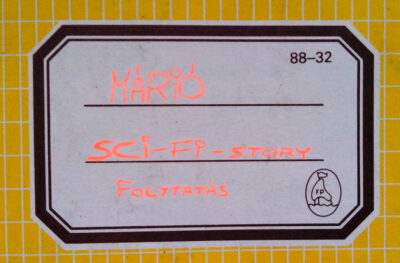
For a long time, I operated under the English pseudonym George M. Stone. It was a natural choice, born from a literal translation and simplification of my real name—I simply ‘dismantled the castle’ from its foundations. I even toyed with the more rhythmic, Spanish-sounding Jorge Castillo de Piedra, but I eventually dismissed it as being far too ornate. George M. Stone was everything a pen name should be: concise, easy to pronounce, and intimately linked to my true identity.
However, as the work neared completion, a friend offered a piece of advice that resonated deeply with me. He argued that a work this personal deserved the signature of its creator.
He told me:
Your own name is a fine name. Be proud of it.
Taking those words to heart, I decided to set the aliases aside and present Star Siblings to the world under my own name.
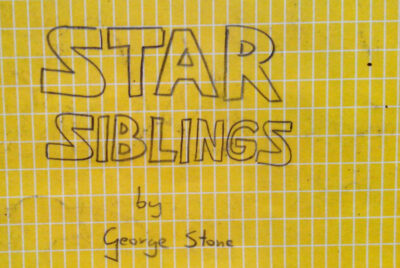
For a long time, the project lacked a formal title, existing only under the utilitarian working name ‘Science Fiction Story.’ I cannot recall the exact moment Star Siblings first entered my mind, but I suspect it took root early in the writing process. I was determined to incorporate the word ‘Star’—a nod to my formative influences, Star Wars and Star Trek—while ‘Siblings’ directly addressed the core bond of the protagonists (spoiler alert: they are, indeed, brother and sister).
I briefly explored Hungarian alternatives, such as Csillagtestvérek or Űrtestvérek, but they lacked the specific resonance and punch of the English title. They simply didn’t sound ‘right’ for the atmosphere I was building.
The final evolution of the title occurred during the editing phase. On the advice of a friend, I added a subtitle: The Orphans of Castor. This addition wasn’t part of the original plan, but it served a dual purpose: it made the book more evocative and offered a subtle, intriguing hint at the cosmic mystery awaiting the reader within its pages.

Those who share my passion for cinema will undoubtedly recognize certain stylistic nods to films that shaped my imagination—from the grand scale of Independence Day and the wit of Boomerang to the vibrant, high-octane world of The Fifth Element. These echoes are my tribute to the visual storytelling that first sparked my desire to create.
However, I must address one element that might seem like an obvious ‘borrowing’ to many: the central motif of the long-lost brother and sister. While it is easy to draw parallels to Star Wars, this was an entirely independent development. I chose this bond not because of genre tradition, but for its unique emotional weight. I needed a connection defined by a profound, shared history and an undeniable loyalty—a charge that only a sibling bond could truly carry within the heart of the story.
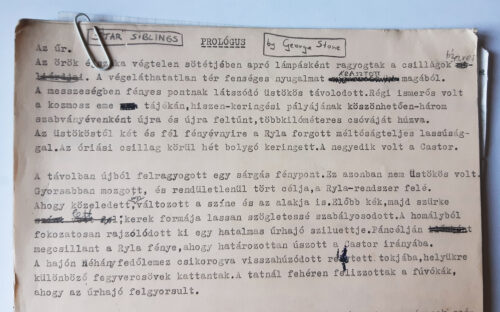
Space. I decided very early on that the novel would begin with this singular, definitive sentence. At the time, I didn’t yet possess a computer or a word processor, so I embarked on the journey by hand. While I typed the prologue on a vintage typewriter, I soon transitioned to a simpler, more intimate medium: a notebook and a pencil.
I chose the pencil for its quiet humility and its practicality. It allowed me to erase, refine, and reshape sentences without the finality of ink or the excessive waste of paper—and, crucially, it offered a silence that the clatter of a typewriter could never provide.
By the end of the process, I had ‘filled’ four entire notebooks. They became a living record of the novel’s evolution, scarred with crossings-out, erasures, marginal notes, and countless revisions. Within those lead-smudged pages, the universe of Star Siblings slowly hummed into life.
The foundation of the narrative was established long before the first word was written. I had mapped out the essential landmarks—the core conflicts, the pivotal twists, and the trajectory of the plot. To borrow an analogy from the world of animation, I had my ‘key points’ (keyframes) firmly in place; my task was then to illustrate the ‘phases’ (in-betweens) that would connect them seamlessly.
One such defining key point was the initial separation of my protagonists. At the dawn of the novel, Dorph and Dabra are strangers to one another, their lives unfolding along two independent, parallel plot threads. The journey toward their eventual meeting became the fertile ground where the story truly expanded. It was during these intervening phases—as one character sought the other—that the world became populated. This was how Sirrah emerged to guide Dorph through his trials, and how Treick became an integral part of Dabra’s path. Their meeting was not just a collision of characters, but the moment two separate streams converged into a single, powerful current.
As the narrative matured, so did the environments my characters inhabited. Initially, I had placed Sirrah’s hideout beneath a gritty tavern—a setting perhaps too reminiscent of the iconic cantinas of Star Wars. To distance her from this cliché and to better align the setting with her soon-to-be-revealed history, I reimagined her base of operations. The rough pub was transformed into a shop; while it remains a functional cover, it offers a sophisticated veneer that better suits her true background.
A similar evolution occurred with the setting of Dabra’s introduction. What was originally the ‘Sirius Bar’ became Old Florence—a more ‘earthly’ and evocative name suggested by my mother. Along with the name change, I elevated the establishment from a common bar to a more exclusive club.
Within the walls of Old Florence, the ‘virtual space battle’ scene remains almost exactly as I first envisioned it. These vignettes—secondary scenes that may not sit at the very heart of the main arc—are vital to the world’s texture. They propel the plot forward while adding essential color to the characters and their evolving relationships. These moments often arrived unbidden during the writing process, spontaneous sparks that breathed life into the silent spaces between my key story points.
By the end of this analog journey, I had filled four large-format notebooks, totaling roughly 160 handwritten pages. When combined with the typed prologue and various structural inserts, I possessed a raw manuscript of approximately 180 pages.
This collection of graphite and ink became the bedrock of the finished novel. However, it was merely the beginning of a new phase: the meticulous process of transformation. My task was to take this dense, unpolished material and reshape it into something more fluid, transparent, and aesthetically refined. It required a shift from the spontaneous energy of creation to the disciplined craft of editing, ensuring that the world of Star Siblings was not only expansive but also deeply readable and immersive for the audience.
The next phase was a laborious one: typing the entire manuscript. This resulted in a draft of nearly 200 pages, yet even this version remained a ‘living’ document, subject to constant corrections and structural additions. To apply the final, professional polish, I realized a computer was indispensable. However, as I still didn’t own one, I had to find an unconventional path forward.
At the time, I was a student at the Foreign Language Training Centre on Rigó Street in Budapest. It was 1999—the dawn of the internet boom—and I was a complete novice in the digital world. Fortunately, the center’s IT administrator was incredibly supportive. Together, we embarked on a proto-digital experiment: we scanned my typewritten pages and processed them through an early Optical Character Recognition (OCR) software.
The resulting digital document was far from perfect—filled with ‘glitches’ and passages the software couldn’t decipher—but it provided the essential foundation. In that primitive Word file, I finally had the workspace to bridge the gap between my analog visions and the polished, readable reality of the novel.

The desire to bring my work home finally led to the acquisition of my first personal computer: a venerable IBM PC PS/2-286 running Windows 3.1. It was a modest machine, but with its word processor, it transformed my bedroom into a private sanctuary of creation.
Having the ability to edit, refine, or simply revisit the world of Star Siblings at will was a revelation. There were moments of quiet pride as I reread my own prose, marveling at the architecture of the story I had built. Yet, as life inevitably intervened, the project experienced periods of dormancy. Months, and sometimes years, would pass as I focused on other chapters of my life, leaving the manuscript to age and settle.
Technology, however, marched on. My trusty IBM finally drew its last breath in 2002. It wasn’t until 2004 that I upgraded to a modern configuration, carefully migrating my precious files from aging floppy disks to a more secure digital future. Through every technological leap, the novel remained a constant companion—a work I would periodically rediscover, polishing a sentence here or a plot point there, slowly bridging the gap between its 20th-century origins and its final, realized form.
At one point, I believed the journey was complete. I even printed and bound a special edition of the novel as a birthday gift for a close friend—a version I considered finalized, polished of every typo and structural flaw. Yet, as life moved forward, Star Siblings slowly retreated into the quiet corners of my desk, becoming what writers call a ‘drawer novel.’
However, time possesses a unique power: it grants the creator the eyes of a stranger. When I returned to the manuscript in 2013, I was struck by a new clarity. With nearly 10 years of distance, I could suddenly see the logical gaps and drafting inconsistencies that had previously remained hidden. I realized that while the soul of the story was intact, the execution required a deeper, more nuanced touch.
I embarked on a transformative editing process. Some scenes were entirely reimagined to enhance realism and dramatic weight, while others—those that had stood the test of time since that first autumn in 1997—remained untouched, their original spark still burning bright.
Key refinements included:
The Armorers: Originally depicted as somewhat dim-witted mercenaries, they were evolved into a formidable, serious military force. I stripped away the unintended comedy to ensure they felt like a genuine threat.
Humanizing the Heroes: Dabra was ‘re-dressed’—not just literally in the virtual battle scene to better suit a romantic encounter, but emotionally as well. She shifted from a terse, ‘robotic’ soldier into a more compassionate and relatable protagonist.
The Convergence: The first meeting between Dorph and Dabra was expanded, allowing their connection to breathe and grow through more intricate dialogue.
Motivation & Shadow: I delved deeper into the antagonists; Corab Bengez’s motivations became clearer, and Erdan’s conflicted loyalty was given a tragic backstory.
What began as a private passion eventually demanded to be shared. I realized that one doesn’t just write for oneself, but for an audience waiting to step through the portal. Star Siblings was no longer just a collection of notebooks; it was a legacy ready to find its readers.
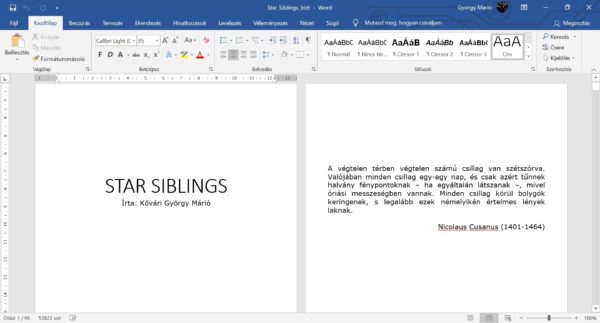
In the summer of 2019, I undertook what I called the ‘next-to-last’ revision—a deep dive into the emotional core of the novel. My primary focus during this phase was to elevate the romantic subplots, ensuring they were as sophisticated and grounded as the technological world they inhabited.
I meticulously reworked these intimate scenes to strip away any remaining clichés, replacing them with a more nuanced realism. I wanted the connections between my characters to feel earned and authentic—reflecting the complexity of human (and galactic) relationships. This final layer of emotional authenticity was the missing piece that truly brought the Star Siblings saga to life, transforming it from a story of survival into a story of the heart.
Early 2021 marked a definitive turning point in the saga’s development. Through extensive collaboration with my friend and editor, Dávid, I embarked on a rigorous structural overhaul. His insights challenged me to strengthen the narrative’s logic and deepen its world-building. Based on our sessions, I moved away from passive exposition toward a more dynamic, immersive storytelling style.
Key Structural & Narrative Enhancements:
Action Over Exposition: Critical information is now woven into the pulse of the plot rather than delivered through static dialogue.
The ‘Everyday’ Galaxy: I recontextualized space travel; owning a starship in this universe is as commonplace as owning a car, grounding the sci-fi elements in a relatable reality.
Deepened Origins: Dabra’s journey to becoming a private investigator was fleshed out, providing a solid foundation for her character’s resilience.
Cultural Expansion: The invading alien race was transformed from a nameless shadow into a distinct culture with its own name and identity.
Internal Monologues: To quicken the pace and increase tension, internal monologues were removed in favor of externalized conflict and character action.
Expanded Relationships: New scenes were added between Treick and Yahmose, as well as a pivotal dialogue between Dabra and Kadack Fedyrno.
The Emotional Core: The most profound change involved the tragic fate of the siblings’ mother—a revision that rippled through the entire narrative, altering motivations and raising the stakes.
This intensive period culminated in a completely reimagined ending. While the story found its true conclusion here, I have preserved the original finale in the Downloads section for those who wish to see the road not taken.
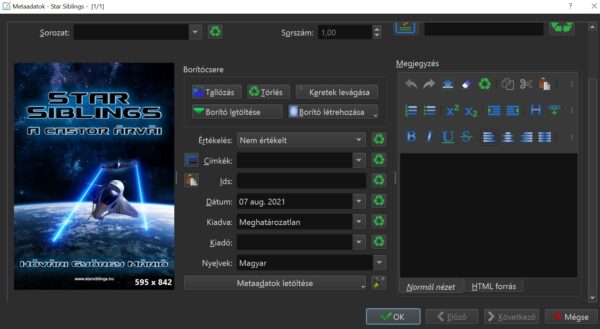
After decades of evolution—from pencil sketches in school notebooks to digital manuscripts on aging floppy disks—I now consider Star Siblings to be complete. The saga is ready to be shared with the world. While I have chosen to bypass the traditional printing press for practical reasons, I am thrilled to present this epic as a high-quality eBook, accessible to anyone who wishes to travel the stars with me.
The journey doesn’t end with the last page. Explore the exclusive extras below to dive deeper into the universe:
Audiobook Samples: Listen to selected chapters, narrated by the author, and hear the story as I first imagined it.
Image Gallery: Browse the visual archives—from early character sketches to the technical blueprints of the ships.
Connect: Have a question or a thought to share? Send me a message; I’d love to hear from fellow travelers.
The eBook: Download the complete novel and begin your adventure today!