

An author must ‘love’ their characters; if the creator remains indifferent to their journey, the reader will find it impossible to identify with them or care for their ultimate fate.
From the very earliest stages of planning, I made a conscious decision: my protagonist would not be a man, but a young woman. My reasons were two-fold. First, I have always been drawn to women of strong character and unwavering resolve. Second, I wanted to challenge the tired tropes of the adventure genre, where men so often occupy the center of the frame while women are relegated to subordinate roles—be they damsels in distress to be rescued or mere ‘eye-candy’ to be claimed by the hero as a trophy at the story’s end. I sought the exact opposite of these clichéd archetypes, and it was from this desire for a genuine, capable hero that Dabra Fedyrno was born.
Dabra’s name was born from the phonetic resonance of Deborah—specifically its shortened form, Debra—as I was drawn to its sharp yet melodic cadence. Her surname, however, underwent a significant transformation. Initially, she shared the same family name as the male protagonist, but as the narrative deepened, I realized that their identical surnames would conflict with one of the story’s central arcs. To preserve the integrity of that mystery, I reshaped her identity, and thus she became Dabra Fedyrno.
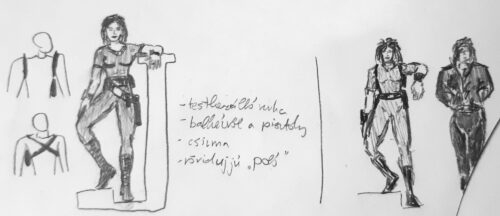
I initially envisioned Dabra as a spiritual successor to the iconic ‘rogue’ archetype—a feminine counterpart to Han Solo. Her attire reflects this practical, adventurous spirit: sturdy boots, tactical side-pocket trousers, a short-sleeved shirt, and a functional jacket. With long brown hair, a striking countenance, and a slender frame, her appearance inadvertently mirrored my own ideals of femininity—a detail pointed out by a friend that I must, in hindsight, concede.
The design process was a series of deliberate choices, even down to the smallest details. Being left-handed myself, I briefly considered bestowing this trait upon her, though I ultimately set it aside as it held no bearing on the narrative. Her weaponry also underwent an evolution: I moved her sidearm from a traditional hip holster to a concealed underarm rig. This was a conscious effort to distance the aesthetic from the ubiquitous ‘open-carry’ culture of Star Wars, opting instead for something more discreet and professional.
Dabra’s role as a private investigator serves as the backbone of her character. It provides a logical framework for her to carry a weapon and places her in high-stakes situations where her sharp instincts and hard-won experience are indispensable. Her age was another point of careful calibration. I placed her in her mid-to-late twenties—old enough to possess the world-weary gravitas and maturity her dialogue demands, yet young enough to remain tethered to the shared history she holds with the male protagonist. Any younger, and her authority would have rung hollow; any older, and the timeline of their past would have lost its cohesion.

The name of the male protagonist, Dorph Bellidys, was born from a blend of reality and pure imagination. I drew his first name from American actor Stephen Dorff, while his surname was a creation of my own. The ‘y’ in Bellidys was a deliberate stylistic choice; I wanted to ensure the name possessed a unique, celestial resonance, distancing it from any unintended linguistic associations.
Dorph’s personality is a study in contrasts. Though he is tall and of a formidable, athletic build, he lacks the arrogance often found in such archetypes. Instead, he is defined by his unwavering loyalty, quiet determination, and persistence. While he is capable of independence, he possesses a rare trait for a hero: the humility to be guided.
This willingness to learn was inspired by a recurring motif I’ve always admired in adventure literature—the seasoned traveler mentoring the uninitiated. I found echoes of this in the unofficial, cult-classic Hungarian Star Wars expansions, as well as in Brian Daley’s Hobart Floyt and Alacrity Fitzhugh trilogy. I found the dynamic so compelling that I wove it into the very fabric of the story. This created a rich, multi-layered relationship between Dorph and Dabra, and similarly between Dorph and the second female protagonist, where growth is as much a part of the journey as the mission itself.

Her name is Sirrah, a melodic derivation of Sarah; her surname, Zoey, was a later addition, conceived in the heat of a scene’s completion.
Sirrah possesses a striking physical presence and an assertive, unwavering demeanor—traits that serve as a carefully constructed shield for a secret known only to a precious few. The nature of this hidden truth is a thread woven deeply into the tapestry of the novel, waiting to be unraveled by the reader.
Unlike my other protagonists, Sirrah’s role was never part of the original blueprint. She emerged organically during the writing process, born from the immediate needs of the narrative. Initially envisioned as a supporting figure to assist Dorph, her charisma and necessity within the world were such that she transcended her initial function, evolving steadily until she earned her place as a central protagonist in her own right

In many ways, Treick Gandimot serves as the masculine mirror to Sirrah; he is Dabra’s partner and a constant pillar of support throughout her trials. As the proprietor of an electronics shop, Treick brings a much-needed levity to the narrative. His habitually cheerful disposition and penchant for humor provide a vital counterpoint to Dabra’s characteristic stoicism and professional reserve—much like Sirrah does for Dorph.
Beyond his wit, Treick is defined by an unshakable reliability. He is the kind of man who would abandon everything at a moment’s notice to rush to the aid of his comrades. This selflessness is not merely a background trait but a core virtue that is emphasized and tested as the story unfolds, proving that in a galaxy of uncertainty, his loyalty is a constant force.
Beyond the central figures of the saga, I developed a diverse array of supporting characters to populate this universe. Some emerged out of narrative necessity—born in the moment to meet the demands of an unfolding event or to provide a crucial perspective to a specific plot thread. Others, however, had a more serendipitous origin.
There were times when a figure I had sketched almost idly during the planning stages—a character not originally intended for the page—captured my imagination so vividly that I felt compelled to write them into the story. In this way, my visual art and my narrative often engaged in a silent dialogue: a striking silhouette or a compelling face on paper would demand its own history, its own voice, and ultimately, its own place in the Star Siblings epic

Dyon Ceru is the quintessential soldier, possessing a stoic demeanor and a commanding presence that demands immediate respect. His name carries a nostalgic spark, inspired by the character Dylan McKay from the iconic teen drama Beverly Hills 90210—yet the man himself is anything but a suburban rebel.
Ceru remains an enigmatic figure within the Star Siblings universe. Little is known of his origins beyond his deep-rooted connection to Sirrah. He is a man bound by a significant, unspoken debt to her—a loyalty so profound that he is willing to command entire military fleets at her request. His character represents the silent power of the professional warrior: a man of few words, but immense strategic weight, whose true history lies buried beneath his unwavering sense of duty.

Tolar Menkhyb enters the narrative as a skilled mechanic who proves instrumental to Dorph during a pivotal encounter. My original vision for Tolar was far more high-tech: I imagined him with sophisticated cybernetic eyes that could be toggled on and off. However, as the scene unfolded, I chose to strip away these augmentations for the sake of narrative grounding.
The decision was twofold. First, the practical requirements of the moment—Tolar needed to examine a physical photograph—made electronic optics feel unnecessary, perhaps even a hindrance to the human connection of the scene. Second, I wanted to maintain a careful balance within the world-building; another character already possessed significant mechanical enhancements, and I felt that doubling down on this trope would diminish its impact. In the end, Tolar’s humanity and his expertise as a craftsman became his most defining traits.

The inception of Proc can be traced back to a single sketch: a man with intricate, RoboCop-inspired lower limbs. My muse for this visual was a cherished 25cm RoboCop action figure that sits in my collection. I was drawn to the contrast between human form and advanced mechanics, and this aesthetic found its home within the narrative.
Proc makes his debut in a pivotal scene where Treick infiltrates a bustling space station in search of critical intelligence. Amidst the neon and steel, this enigmatic, ‘robot-legged savant of engineering’ appears, offering his unique expertise. Much like Tolar, I was so captivated by the distinct silhouette and the potential of his character that I couldn’t simply let him fade into the background. I was compelled to ‘bring him back,’ weaving him deeper into the tapestry of the story, where his cybernetic enhancements and technical brilliance continue to leave their mark.

Erdan Mintaka was initially conceived as a subversion—a stylized caricature of the quintessential, ‘cool’ starfighter pilot. Brash, talented, and perhaps a bit too conscious of his own legend, he enters the story as a formidable adversary.
However, beneath the cockpit’s bravado lies the most profound character arc within the novel. As the conflict escalates, Erdan undergoes a transformative journey that challenges his allegiances and his very identity. While he begins his journey on the opposite side of the front lines, his evolution is one of the narrative’s most significant shifts… though to reveal where his path ultimately leads would be a spoiler I’m not yet ready to share.
One of Sirrah’s closest companions and ‘collaborators,’ Wakka, was a purely spontaneous creation. He was never part of my initial sketches; he simply emerged from the ink as I wrote. A classic comic-relief figure, Wakka possesses a truly surreal anatomy—most notably, his three legs. I borrowed his name from a speculative creature in Dougal Dixon’s renowned work, After Man, bringing a touch of evolutionary curiosity to the cast.
At the other end of the moral spectrum stands the primary antagonist, Corab Bengez. An elderly man who aids the extraterrestrial invaders, Bengez was initially conceived as a more traditional, perhaps even clichéd villain. However, as the story progressed, I found his earlier, more one-dimensional outbursts inconsistent with the gravitas I wanted him to possess. I chose to breathe more life into him, crafting a nuanced backstory and a complex set of motivations. He evolved from a mere obstacle into a shadow-self with his own rationale and history.
The foundation was finally laid: the universe was mapped, the characters were breathing, and the stage was set. Now, the true challenge remained—to actually write it.